
It’s called Bazaar. It’s on GitHub. I built it in between helping customers at the Pokemon shop with my buddy Claude.
The question that wouldn’t leave me alone
A few months ago I noticed a pattern. I’d describe some tool to an AI coding assistant — a card price guide wired to my collection, a gallery that listed every card in a set the way I wanted to see them, a little marketing app for a specific thing I was running that week — and an hour later I’d have a working app.
The thing is, every one of these was deeply specific to me. Nobody else needs a price guide for my cards. Nobody else needs my set gallery. These weren’t products. They were tools-of-one.
Then I’d close the laptop and never use it again. Because what do you actually do with a thing like that? My options were always the same two: shoehorn it into some larger app I already have running, or stand up a whole new server just for it. Bolting it onto something bigger muddies the bigger thing with features that don’t belong. Spinning up fresh infrastructure for a tool I’ll use twice a week is absurd. So most of the time I’d pick neither, and the tool would quietly die.
So I had a pile of perfectly working software that never made it past the preview pane. And one question kept nagging until I couldn’t ignore it:
Why can’t I just… run this on my WordPress site?
WordPress runs nearly half the web. It’s battle-tested, stable, and most of us already have one humming along somewhere. The question wasn’t “how do we replace it?” — it was “why isn’t it doing more for me?” What if the admin dashboard I already trust could host the little tools I keep building?
If you’ve been following along the last few weeks, you’ve watched me post a string of small WordPress experiments — plugins, admin tweaks, half-formed ideas. They felt like scattered curiosities. They weren’t scattered at all. They were me circling this same question from every angle. Bazaar is where they land.
What it is
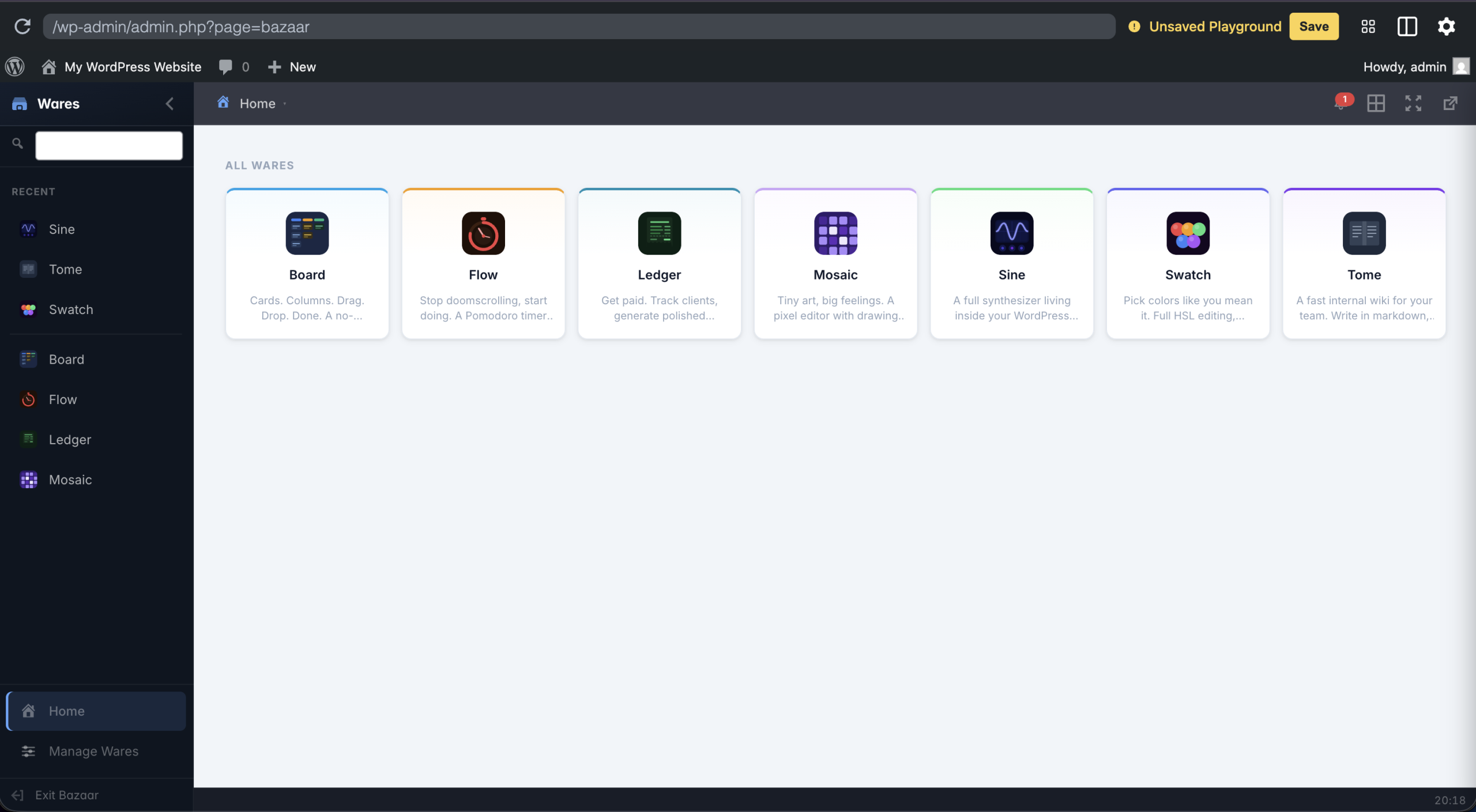
Bazaar is a WordPress plugin that turns your admin dashboard into an application platform. Install it, and your sidebar grows a new launcher. Zip up a web app, upload it, and it appears as an icon. Click the icon, the app runs — inside your dashboard, on your server, on infrastructure you already own.
That’s the whole pitch. Upload a zip, get an app.
Under the hood there’s the usual grown-up stuff — sandboxed apps, a real manifest format, a clean API surface, WP-CLI tooling — but I’ll save that for another post. The headline is the simple part.
I’ve been using it for weeks myself. Every sample app in the repo — Swatch (color palettes), Flow (Pomodoro), Ledger (expenses), Board (kanban), Mosaic (pixel art), Sine (web audio synth), Tome (document editor) — I built on Bazaar to stress-test the platform and to prove to myself that the loop actually works. None of them needed their own server. They all just live in the admin sidebar.
Why it matters
We’ve made building software easier by an order of magnitude, and making room for software about as hard as it’s always been.
If you’ve been building with AI, you know the feeling. The prototype is magical. The demo is magical. Then you hit the deploy question and suddenly there’s a new service to stand up, a new bill to track, a new dashboard to log into. Bazaar’s job is to move that goal line closer: AI helps you make a thing, you zip it, you drop it into your site, the thing exists.
Software that lives where you already live.
About the name
I named it after Eric Raymond’s The Cathedral and the Bazaar — the 1999 essay on how open source actually works. Cathedrals are planned, centralized, stable. Bazaars are messy, decentralized, experimental. Both are valuable. Both are necessary.
WordPress is a cathedral, and thank god for that. The web needs software polished over two decades, stable across millions of installs, reliable enough to bet a business on. But cathedrals aren’t where you build one-off tools, experiments, personal software that only has to work for you and three friends. That’s what bazaars are for.
Bazaar doesn’t compete with the cathedral. It opens a little marketplace alongside it. Your WordPress site stays exactly what it’s always been. Now, in a corner of the admin sidebar, there’s a place for your experiments too.
On building this with Claude
Bazaar was built the way I’m hoping Bazaar apps will be built. I’d describe a feature, Claude and I would hash out the approach, I’d steer, it would type, I’d review. Which means — and this is the part that makes me smile — the first serious test of “can AI and a motivated human build real software together?” is also the thing that exists to let other people do exactly that. The platform was built on the premise it’s trying to enable.
What I want from you
Try it and tell me what breaks.
No install, no download, no risk. One click spins up a fresh sandboxed WordPress in your browser with Bazaar already running:
→ Try Bazaar in the WordPress Playground
Poke around. Upload apps. Break things. Close the tab and it disappears.
If anything feels weird, open an issue on the repo. Bug reports are gold. So are “this was confusing” notes. And if you build something good, send it — I want a proper gallery of Bazaar apps on the site.
This is the most fun I’ve had on a project in years. I believe this is how software for individuals gets made from here on — AI-assisted, hosted on infrastructure you already own, weird, specific, yours.
The cathedral stands. The bazaar is open. Come poke around.