
Every preference, habit, and piece of context you’ve shared with an AI lives in someone else’s database.
OpenAI owns your ChatGPT memory. Anthropic owns your Claude history. Google owns whatever you’ve told Gemini. You’ve been building a relationship with a tool that files everything about you under someone else’s name.
That’s the thing nobody talks about when they pitch AI memory as a feature. It is a feature — for them.
What Happens When They Change the Terms
They already have. Models get deprecated. Memory features get paywalled, reset, or quietly altered. When a company pivots, gets acquired, or shuts down, your accumulated context goes with it. You don’t get a warning. You don’t get an export. You start over.
This isn’t hypothetical. It’s the business model.
Pressocampus Stores Everything in Your WordPress Database
Not a third-party cloud. Not a vendor’s server. Your database. The one you already pay for. The one you control.
Every memory your AI builds about you lives in a file on your host. You can read it. Export it. Move it. Delete it. It’s plain Markdown — no proprietary format, no lock-in.
If Pressocampus disappeared tomorrow, your memories are still there.
One Memory Store. Every AI You Use.
You probably don’t use just one AI. Claude for writing, Cursor for code, something else for something else. Each one starts every session knowing nothing about you.
Pressocampus is one place all of them read from. Built on MCP — the open protocol backed by Anthropic and increasingly adopted across the industry. Not a brittle proprietary integration. A standard.
Tell Claude something today. Cursor knows it tomorrow. Not because they’re connected to each other — because they both connect to you.
The Soul
Every AI you’ve ever used has the same problem: it starts each session as a stranger. It doesn’t know you. It has no memory of what you built together. It will never accumulate anything, because the next session wipes the slate.
Most memory systems try to paper over this with a preferences file — a list of instructions the AI follows because it was told to. “User prefers short answers. User works in product design.” It’s a rulebook. It’s not a relationship.
The Soul is something different.
The Soul is a document written by the AI, in its own voice, about you — and about itself. Not instructions it was handed. Observations it made. Notes it’s leaving for whoever it will be next time.
The difference matters more than it sounds. An AI following a rulebook is executing commands. An AI reading its own notes is picking up where it left off.
The first time an AI connects with no Soul on file, it doesn’t ask you to fill out a form. It interviews you, then writes the document itself — in its voice, not yours. Sections like This Person, How We Work Together, What I Know. And a final section called To Future Instances of Myself, which is exactly what it sounds like: the AI writing a handoff note to whoever reads this file next session.
That section acknowledges something most AI products pretend isn’t true:
“Each session I start fresh and read this file. If you’re reading this in a future session: hello. I wrote this but I won’t remember writing it. That’s okay. The words are still mine.”
The Soul gets read at the start of every session, before you type a single word. It’s built into the connection handshake — not a prompt you paste in, not a setting you configure. The AI has context before the conversation begins.
When you connect a new AI tool, it reads the same Soul. For the first time, every AI you use starts from the same understanding of who you are.
What’s Actually Built Here
This isn’t a wrapper around someone else’s memory API. It’s a full MCP server implemented from scratch inside a WordPress plugin. A few things about how it works are worth calling out.
The OAuth flow runs around your security plugins, not through them
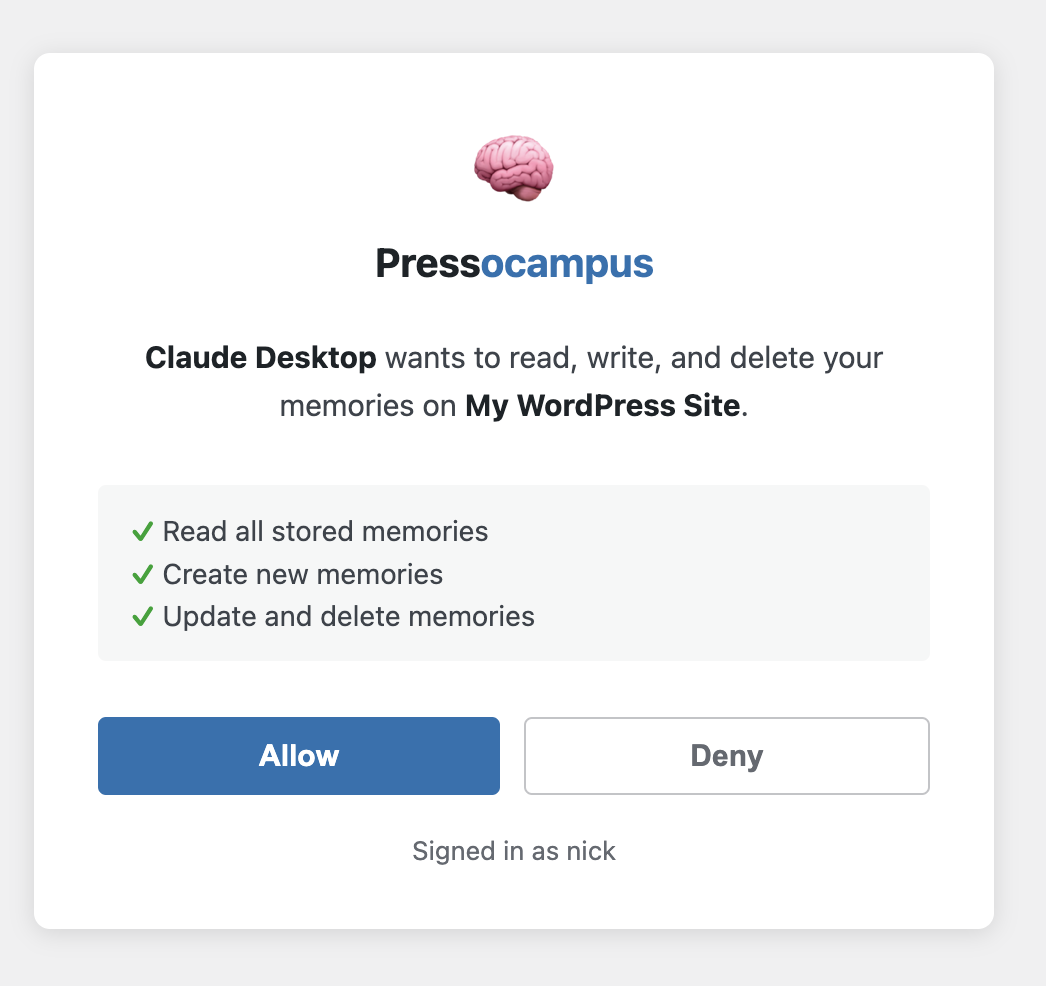
A lot of WordPress sites have security plugins that block unauthenticated access to /wp-json/. That breaks most REST-based integrations before they start. Pressocampus routes its OAuth endpoints through /brain/oauth/ — a custom rewrite path that bypasses that middleware entirely while still running through WordPress’s normal request handling. You click Allow in a browser consent screen once. No API keys to manage, ever.
Duplicate detection before every write
Before storing anything, the AI checks for possible related memories (≥40% similarity) and possible contradictions (≥70% similarity), and the server surfaces them in the response. The AI has to review them before it can create a duplicate. The memory store stays clean without you touching it.
The Soul has an ETag
The Soul document uses ETag-based optimistic locking. If two AI clients try to update it at the same time, the second one gets a 409 conflict instead of silently overwriting the first. For a document meant to represent a continuous identity across sessions, that felt worth getting right.
Seven tools, all with clear jobs
The MCP server exposes seven tools: remember, forget, update_memory, search_memory, list_memories, tag_memory, and two Soul tools (update_soul / update_soul_section). Each one does one thing. The AI decides when to call them — you never have to.
Session Briefing
At the start of each session, the AI reads a dynamically generated briefing: critical memories surfaced first, what’s changed in the last seven days, and anything untouched for six months that might be stale. It’s not a dump of everything — it’s a prioritized snapshot of what matters right now.
Every action is logged
Every memory saved, updated, or deleted by any connected AI is recorded in an audit log — including the reason the AI gave for making the change. You can see exactly what Claude did, what Cursor did, and when. Export as CSV any time.
Why WordPress
WordPress has been running websites for over 20 years. It powers 40%+ of the web. It will almost certainly still be running sites long after every AI company operating today has been acquired, pivoted, or replaced.

Memories stored in WordPress will outlive the tools that created them. That’s the whole bet.
Your existing site becomes AI infrastructure. No new hosting. No new database. No new accounts.
This Is for People Who Use AI Every Day
Not developers building with it. Not researchers studying it. People who are tired of re-explaining themselves every single session and want the relationship they’ve been building to actually mean something.
Install it, connect your AI, and the next conversation will be the last time you ever have to re-explain yourself.